Major Legal Escalation in Spanish Football’s Biggest Scandal
FC Barcelona has been officially summoned to court. The club faces charges of corporate corruption and fraud in the ongoing Negreira scandal. This represents one of the most serious corruption investigations in Spanish football history.
The case centers on approximately €7.2 to €8.4 million in payments. Barcelona made these payments to companies owned by José María Enríquez Negreira. Negreira served as vice president of Spain’s Technical Committee of Referees (CTA) from 2001 to 2018. The payments occurred during his entire tenure in this influential position.
The Heart of the Controversy: Missing Contracts and Documentation
A Barcelona court issued a dramatic order. The court demanded that FC Barcelona produce the original contracts and records connected to these payments. The club has 20 days to comply.
Investigators have made a troubling discovery. They found no trace of the original documents in the club’s archives. This absence has significantly heightened suspicions. Questions surround the true nature of Barcelona’s relationship with Negreira.
The court made specific requests. It demanded documentation related to contracts with Negreira’s companies, Dasnil 95 SL and Nilsad SCP. These companies allegedly provided “paid refereeing advisory services” between 2001 and 2018.
Judicial authorities want proof of the supposed advisory work. They requested written analyses, reports, or correspondence. However, Spanish authorities reached a damning conclusion in 2024. They found that no such reports existed. Officials referred to them as “phantom reports.”
Barcelona made a significant admission in 2021. The club stated it had no record of formal contracts with Negreira’s companies. This makes the court’s demand particularly critical for the ongoing investigation.
Court Testimonies: Key Figures Called to Testify
The judicial proceedings have entered a decisive phase. Authorities scheduled a series of high-profile testimonies:
December 12, 2025: Current Barcelona president Joan Laporta will testify as a witness. Former coaches Luis Enrique and Ernesto Valverde will also appear. Luis Enrique now manages Paris Saint-Germain. Valverde currently coaches Athletic Club. The court originally set the hearing for November 25. Scheduling conflicts among lawyers forced a postponement.
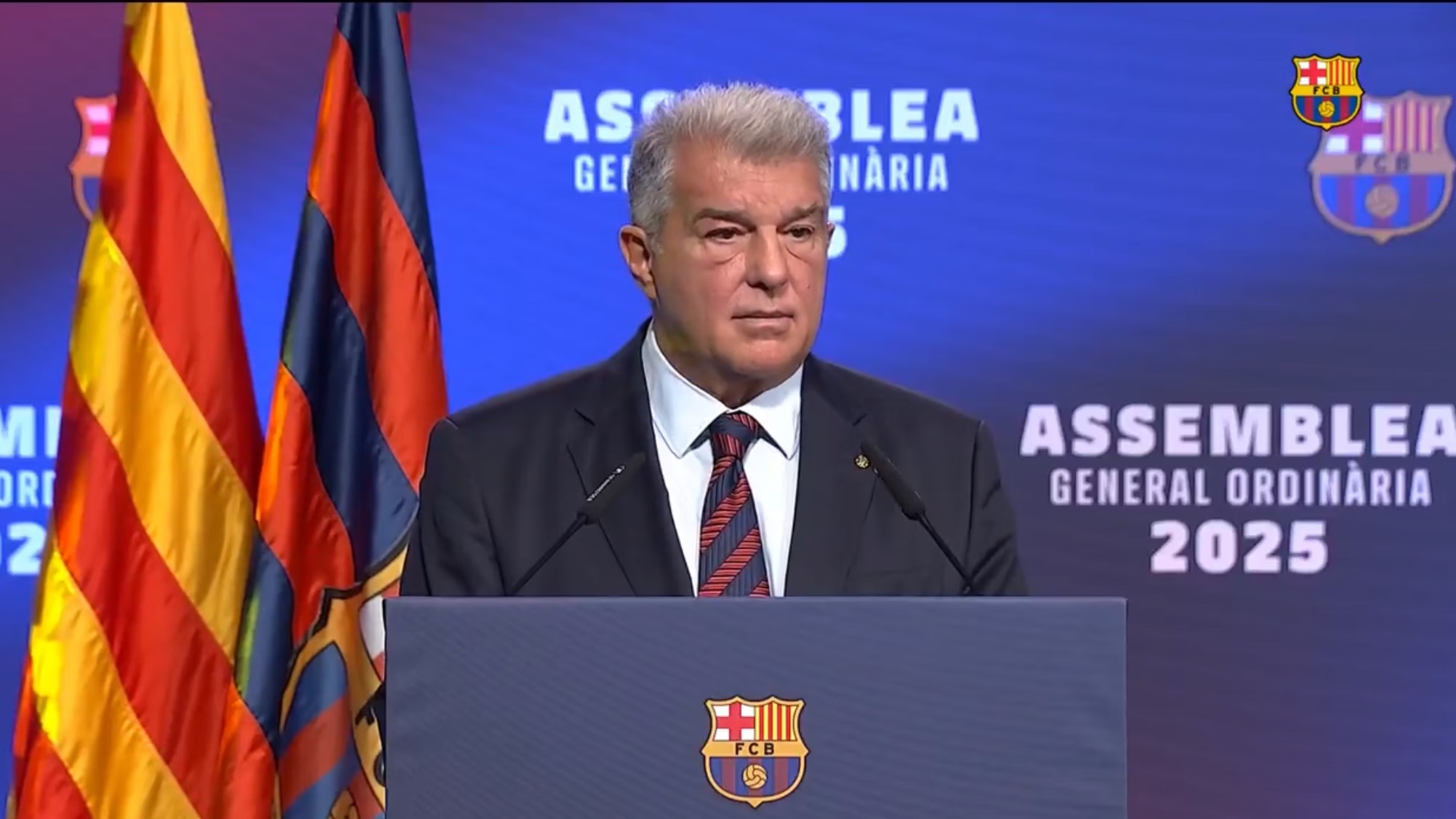
Prosecutors want Laporta to explain payments made during his first presidential term. He served from 2003 to 2010. They specifically want him to address “payments made to Enríquez Negreira’s shell companies”. Laporta was initially under investigation. However, charges against him were dismissed due to the statute of limitations. He will appear strictly as a witness.
Authorities summoned Luis Enrique, who managed Barcelona from 2014 to 2017. They also called Ernesto Valverde, who led the team from 2017 to 2020. Prosecutors want to determine whether Negreira’s alleged referee reports influenced the team’s sporting strategies. They will examine if the reports affected match preparations during their respective tenures.
January 27, 2026: FC Barcelona will appear in court as an institution. Vice president Elena Fort will represent the club. This marks a significant escalation. The club faces charges as a corporate entity for sporting corruption.
Early February 2026: Authorities summoned former president Joan Gaspart to testify as a witness. He will address payments made during his tenure from 2000 to 2003.
Courts have already heard testimonies from former Barcelona presidents. Josep Maria Bartomeu and Sandro Rosell both defended the arrangement. They insisted the services were strictly technical. However, conflicting testimonies and the continued lack of verifiable documentation have heightened judicial scrutiny.
Conflicting Evidence and Damaging Testimony
The case took a dramatic turn in September 2025. Javier Enríquez Romero testified against his father and the club. He is Negreira’s son. He allegedly authored over 600 reports for Barcelona.
Enríquez Romero made damaging claims. He stated he personally made only €60,000 from the relationship. According to El Español, he allegedly denied that the referee analysis reports were the true reason for the payments. He described Barcelona’s payments to his father as “unethical”.
This testimony contradicts Barcelona’s official explanation. The club claimed the payments were for legitimate consulting services. They said these services provided technical reports on referees.
Former Barcelona presidents maintained their innocence. Josep Maria Bartomeu and Sandro Rosell both stated that no wrongdoing occurred under their tenure. Bartomeu noted he only met Negreira in person by chance on one occasion.
The Financial Trail: Where Did the Money Go?
Barcelona made substantial payments between 2001 and 2018. The total ranged between €7.2 and €8.4 million to companies owned by Negreira. Officials labeled the payments as fees for “technical refereeing advice” and “consultancy reports”.
The breakdown reveals payment patterns by presidential term:
- Sandro Rosell’s presidency (2010-2014): Approximately €1.5 million transferred to Dasnil 95
- Josep Maria Bartomeu’s presidency (2014-2020): Approximately €5.5 million in payments
Authorities discovered additional complications. They found approximately €3 million in accounts belonging to Negreira’s wife, Ana Paula Rufas. Investigators claim they cannot account for this money. Authorities accused Rufas of money laundering in connection with the case.
Barcelona president Joan Laporta provided context for the payments. He noted the €7-8 million was paid across 18 years. This averaged around €400,000 annually. However, the money paid to Negreira increased over time. Laporta claimed that in 2010, the price went up. He said the club needed scouting data and video analysis on a wider range of competitions.
What Barcelona Claims vs. What Investigators Found
Barcelona has consistently defended its actions. The club maintained that these payments were for legitimate consulting services. Officials specifically cited technical reports on refereeing tendencies and scouting information. The club insists the money was paid transparently. They claim it was for lawful referee assessments and scouting advice.
Negreira provided his own explanation in October 2021. He spoke to Spanish tax authorities about his services. He explained that his work consisted of “going to watch the games, personally or through fellow former referees, and being informed of why the decisions had been made.”
Negreira claimed Barcelona wanted to ensure “neutral” treatment. He stated the club wanted to ensure “no decisions were made against the club”. He added: “FC Barcelona considered that the team was harmed and other teams were favored”.
Spanish prosecutors tell a different story. They allege that Barcelona bought favor from match officials. The prosecutors claim the club aimed to influence results. According to the prosecutors’ report filed in March 2023, the club and former executives had an agreement. This agreement was for Negreira to “carry out actions aimed at favouring Barcelona in the decision-making of the referees in the matches played by the club, and thus in the results of the competitions”.
Former Barcelona coach Ernesto Valverde stated that the reports were never made available to him. He took over only in 2017, just before the club’s relationship with Negreira ended. Current manager Xavi Hernández said he was aware of them during his playing days.
Sources at five different Spanish clubs raised concerns. They told ESPN that Barcelona’s alleged spend on these services seemed excessive. They compared it to what other clubs typically pay for similar referee analysis reports.
Legal Charges and Current Status
FC Barcelona now faces formal charges as a legal entity. The charges include continuous business corruption and fraud. Multiple individuals also face prosecution alongside the club.
The charges against the club, former presidents, and the Negreira family include:
- Sports corruption: The primary charge focuses on alleged efforts to influence refereeing decisions
- Corruption in business: Related to the commercial nature of the alleged scheme
- False administration: Concerning how authorities approved and documented the payments
- Falsification of commercial documents: Related to the contracts and invoicing
A Barcelona court made an important ruling in May 2024. It dismissed bribery charges against Barcelona and several of its current and former presidents. The court ruled that Negreira was not considered a public official under Spanish law. This was a significant development. A bribery offense in Spain requires specific proof. Prosecutors must show that a public official requested money for an influenced decision.
However, the investigation has continued under the broader charge of sports corruption. Judge Alejandra Gil extended the investigation’s instruction phase by six months in September 2024. The case now continues until at least March 2026.
Investigators have conducted extensive work. Over two years, they performed raids and seized documents. Spain’s Civil Guard conducted financial forensics. Yet investigators have not produced definitive proof of bribery or referee manipulation.
Barcelona issued a statement in September 2024. The club’s annual financial report stated that authorities found no evidence of corruption within a sporting context so far. The report noted it was still too early to determine potential financial or sporting consequences.
Broader Implications for Spanish Football
The Negreira case has triggered widespread debate. Questions surround transparency, governance, and ethics in Spanish football. UEFA president Aleksander Čeferin made a strong statement. He called it an “extremely serious situation, one of the most serious I have seen since I have been involved with football”.
UEFA opened its own independent investigation in March 2023. The organization considered possible punishments. These include Barcelona being excluded from the Champions League. However, authorities have imposed no such sanctions to date.
Multiple institutions joined the prosecutors’ complaint. LaLiga, the Royal Spanish Football Federation (RFEF), and Real Madrid are among them. Real Madrid acts as a private prosecutor. The club requested the case be extended into 2026. This would allow for deeper financial analysis.
Spain’s statute of limitations creates complications. The law sets a three-year limit for sporting investigations. The payments stopped over five years ago in 2018. This means LaLiga itself cannot investigate or impose sporting punishments. However, investigations by the Royal Spanish Football Federation and Spain’s High Council for Sports may follow. These would come after the current legal proceedings conclude.
Potential Consequences for Barcelona
Barcelona could face severe repercussions if found guilty. The consequences span both legal and sporting domains:
Legal penalties: Courts could impose significant fines. Individuals found responsible could face possible jail terms. If convicted of sports corruption, Barcelona could face fines up to €5 million.
Sporting sanctions: Authorities have not determined sporting punishments yet. Media discussions have mentioned potential consequences. These include points deductions, trophy withdrawals, or even relegation. However, these remain speculative. Authorities have not established evidence of specific match-fixing.
Reputational damage: The scandal has already damaged Barcelona’s reputation significantly. The club stands as one of football’s most prestigious institutions. This controversy has called the club’s motto into question. “Més que un club” (More than a club) faces scrutiny.
Financial impact: Barcelona struggles with financial difficulties. The club faces La Liga’s salary cap restrictions. These could be compounded by substantial fines if the club is found guilty.
What Happens Next
The case has entered a critical phase. Multiple key testimonies are scheduled over the coming months:
- December 12, 2025: Joan Laporta, Luis Enrique, and Ernesto Valverde testify as witnesses
- January 27, 2026: FC Barcelona appears as a corporate entity facing charges. Elena Fort will represent the club.
- Early February 2026: Former president Joan Gaspart testifies as a witness
The club faces immense pressure. Barcelona must produce evidence and documentation. These materials could determine whether the case represents administrative failure. They could also reveal something far more serious. The outcome could stain Barcelona’s reputation for years to come.
Barcelona must meet strict deadlines. The club must submit the original contracts with Negreira’s companies within 20 days of the court order. They must also identify the technicians and assistants who helped with the claimed reports. Barcelona must provide photos, videos, or original copies. These materials must prove the payments were indeed for legitimate services.
Judge Alejandra Gil provided an update on case progress. She stated the case remains “practically in the same situation” as it was six months earlier. She cited difficulties in scheduling testimonies. Conflicts among the lawyers involved caused delays. The investigation has been extended until March 2026.
Sources familiar with the investigation provided a timeline perspective. They indicated the case could take several years to reach a final conclusion. This reflects the number of charges and witnesses involved.
The judicial process continues to unfold. Fans, stakeholders, and the broader footballing community watch closely. The court’s findings will shape Barcelona’s immediate future. They will also impact the reputation of Spanish football on the world stage.