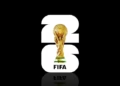
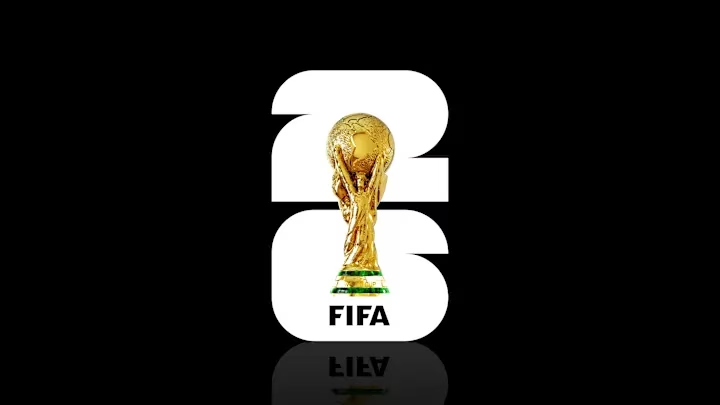
The highly anticipated 2026 FIFA World Cup draw is taking place on Friday, December 5, 2025, marking a historic moment for international football. This ceremony will determine the group stage assignments for 48 teams competing in what will be the largest World Cup tournament ever held, featuring 16 more teams than the previous 2022 Qatar edition.
When Is the 2026 World Cup Draw Happening?
The draw ceremony officially commenced at 12:00 PM ET (5:00 PM GMT) on December 5, 2025, at the prestigious Kennedy Center in Washington, D.C. The event marks the first time the United States will host a World Cup draw ceremony, adding significant prestige to the proceedings.
For international viewers, the timing varies by region. In the United Kingdom, the ceremony started at 5:00 PM GMT on BBC One and BBC iPlayer. Indian audiences can access live streaming through FIFA+ at 10:30 PM IST. Australian viewers are catching the broadcast on SBS and SBS On Demand on Saturday morning, reflecting the time zone difference.
The Unprecedented Tournament Format
The 2026 World Cup represents a groundbreaking evolution in the tournament’s structure. For the first time in the competition’s history, 48 teams will participate in the main draw, divided into 12 groups with four teams each. This expansion from the traditional 32-team format fundamentally changes how the competition will operate.
The tournament will be co-hosted by three nations for the first time: the United States, Canada, and Mexico. This joint hosting arrangement has already influenced group assignments, with Mexico pre-assigned to Group A, Canada to Group B, and the USA to Group D.
Understanding the Pot System
FIFA employs a sophisticated four-pot system to ensure competitive balance across all 12 groups. The 42 already-qualified teams are distributed as follows:
Pot 1 (Seeded Teams): The 12 highest-ranked nations, including the three hosts plus the top nine FIFA-ranked teams. This pot comprises Canada, Mexico, USA, Spain, Argentina, France, England, Brazil, Portugal, Netherlands, Belgium, and Germany.
Pot 2: Strong qualifying nations placed in this tier include Croatia, Morocco, Colombia, Uruguay, Switzerland, Japan, Senegal, Iran, South Korea, Ecuador, Austria, and Australia.
Pot 3: Mid-tier qualified teams feature Norway, Panama, Egypt, Algeria, Scotland, Paraguay, Tunisia, Côte d’Ivoire, Uzbekistan, Qatar, and Saudi Arabia.
Pot 4: This category includes the six playoff winners and the lowest-ranked qualifying teams. Positions in Pot 4 remain partially unfilled until all qualifying playoffs conclude.
Key Draw Procedures and Restrictions
The draw follows specific procedural rules to maintain competitive fairness. Teams from each pot will be systematically allocated into the 12 groups, with important geographical constraints enforced. Most notably, no more than two European nations can be placed in any single group, though UEFA teams already represent a significant portion of the 48-team field with 16 European representatives.
Teams from the same confederation cannot be drawn together—with the sole exception of UEFA (European) nations, where limited overlap is permitted due to the higher concentration of European qualifying teams.
Coverage and Broadcasting Information
The draw ceremony received comprehensive global television and digital coverage. In the United States, Fox provided extensive coverage with a pre-show beginning at 11:30 AM ET before the draw started at noon. For Spanish-language audiences in the US, Telemundo and Telemundo Deportes offered simultaneous broadcasting.
UK viewers accessed coverage through BBC One and BBC iPlayer starting at 5:00 PM GMT. Canadian audiences watched through TSN and its YouTube channel. Australian viewers caught the broadcast on SBS, SBS Viceland, and SBS On Demand.
Globally, FIFA+ and FIFA’s official social media channels streamed the ceremony live, ensuring accessibility across all major markets.
The Spectacle and Entertainment
Beyond the draw mechanics, the ceremony featured significant entertainment and political elements. Former England captain Rio Ferdinand conducted the draw procedure with broadcaster Samantha Johnson assisting. The event was hosted by supermodel Heidi Klum, comedian Kevin Hart, and actor-producer Danny Ramirez.
The ceremony included live musical performances from international artists including Andrea Bocelli, Robbie Williams, and Nicole Scherzinger. Additionally, speeches were delivered by FIFA President Gianni Infantino and US President Donald Trump, underscoring the tournament’s political and diplomatic significance.
What Teams Learn and What Comes Next
Following the December 5 draw, all competing nations learned their group opponents and initial match dates. However, additional information remained unrevealed. Teams had to wait until December 6, 2025, for the complete match schedule announcement, which would reveal specific venues and kick-off times for all matches.
For groups featuring host nations (Groups A, B, and D with Mexico, Canada, and the USA respectively), venues were already designated, though exact kick-off times awaited the December 6 announcement. For the remaining nine groups, both venue and kick-off times were revealed on December 6 during a secondary broadcast event at 12:00 PM ET.
Tournament Timeline and Next Steps
With the draw complete, the focus shifts to final preparations for the tournament proper. The group stage matches are scheduled to commence on June 11, 2026, with the tournament continuing through late June. The knockout rounds will follow, culminating in the final match later in summer 2026.
This expanded format provides unprecedented opportunities for global participation while presenting logistical challenges across three nations. The December 5 draw ceremony represented the culmination of qualifying campaigns spanning two years and marked the official beginning of the competitive phase for world football’s most prestigious tournament.