
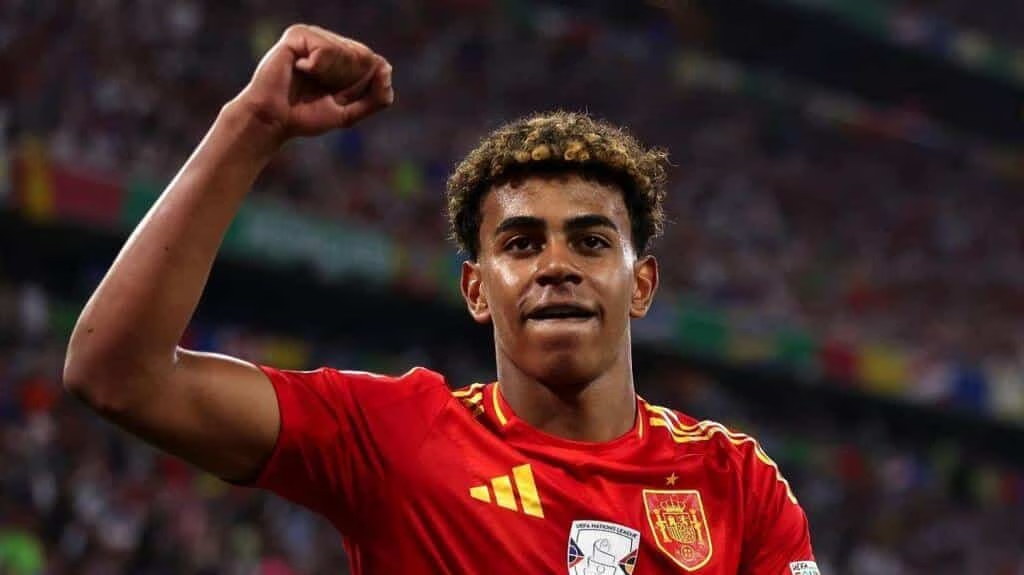
The ongoing tension between Spain’s national team and Barcelona over teenage sensation Lamine Yamal’s fitness has reached a critical point, with Spain manager Luis de la Fuente publicly expressing his displeasure at being left in the dark about medical procedures performed on the 18-year-old winger.
The Controversy Unfolds
The situation escalated dramatically on Monday, November 10, 2025, when Barcelona’s medical staff administered an invasive radiofrequency procedure to treat Yamal’s persistent pubalgia (groin discomfort) without prior notification to Spain’s national team medical personnel. The Spanish Football Federation (RFEF) learned of the treatment at 1:47 PM that afternoon—the very day Spain’s training camp officially began—and received the detailed medical report only at 10:40 PM, which recommended seven to ten days of rest.
De la Fuente did not mince words when addressing the communication breakdown. “I had never experienced a situation like that. I don’t think it’s very normal,” the Spain manager told Radio Nacional de España. “You don’t know, you haven’t heard anything, you don’t know any details, and then they tell you about health issues. You’re left surprised.”
Speaking to Cadena COPE, de la Fuente reinforced his position: “Surely we should have been informed that he was going to receive that treatment beforehand, not afterward”. The manager emphasized that improved dialogue and information-sharing between Barcelona and the national team represents “the key” to maintaining better relations between both parties.
RFEF’s Official Response
The Royal Spanish Football Federation released a strongly-worded statement expressing their “surprise and concern” over the circumstances surrounding Yamal’s withdrawal. The statement emphasized that the radiofrequency procedure was “carried out without prior communication to the national team’s medical staff”.
“In light of this situation, and with the player’s health, safety, and wellbeing as the top priority, the Royal Spanish Football Federation has decided to release the player from the current squad,” the statement concluded. The Federation also expressed hope for Yamal’s “positive recovery” and wished him a “swift and complete return to full fitness”.
Understanding the Medical Procedure
The radiofrequency treatment Yamal underwent is a minimally invasive medical technique designed to address chronic pain caused by pubalgia. The procedure involves applying controlled electrical currents through special electrode needles, guided by X-ray or ultrasound imaging, to target specific nerves responsible for the patient’s pain.
There are two types of radiofrequency treatments: conventional radiofrequency, which uses heat on the selected nerve to mitigate pain signals, and pulsed radiofrequency, which modulates pain sensation without damaging the nerve. The procedure is performed on an outpatient basis and does not require hospitalization, allowing patients to resume normal activities shortly afterward.
Barcelona brought in renowned Belgian surgeon Ernest Schilders, an internationally recognized specialist in pubalgia and groin injuries in athletes, to perform the treatment alongside Dr. Ricard Pruna, the club’s head of medical services. Professor Schilders has performed over 3,000 hip arthroscopies and is considered a leading authority on adductor, inguinal, hamstring, and pubic-related groin pain.
Barcelona’s Defense
Barcelona quickly responded to the Spanish FA’s criticism, with club sources telling EFE that they acted “responsibly and in coordination” with the player and his medical needs. The club strongly denied suggestions that the procedure was carried out behind the Federation’s back, insisting they communicated “immediately” with the RFEF.
According to Barcelona, the treatment decision was made collectively after Belgian specialist Ernest Schilders assessed Yamal at the Ciutat Esportiva the day after the match against Celta Vigo. During that joint assessment, Schilders and Barcelona’s doctors determined that while Yamal’s condition was improving, a targeted intervention would accelerate his recovery.
A History of Conflict
This latest incident represents just another chapter in an increasingly contentious relationship between Barcelona and Spain regarding player management. The flashpoint occurred in September 2025, when Yamal first returned from international duty with the groin issue.
Barcelona manager Hansi Flick publicly accused Spain of failing to properly care for their players, stating: “It’s a shame. He already left here in pain. They gave him painkillers, and he played 73 and 79 minutes. And between games, he didn’t train. That’s not taking care of the players”. Flick added: “Spain has the best players and the best national team, but they haven’t taken care of the players and that’s all I can say. I’m very disappointed”.
De la Fuente responded to Flick’s criticism by saying he “lacked empathy,” particularly given the German coach’s experience working with national teams. “There is no conflict with Hansi Flick,” de la Fuente later clarified. “He’s been a national team coach and knows how we coaches behave. I thought he empathised with that. I was surprised that a former national team coach would think that way”.
Impact on Yamal’s Season
The groin issue has significantly impacted Yamal’s availability this season. The talented winger has missed five matches for Barcelona due to the recurring problem. He also sat out Spain’s October international fixtures because of an aggravation of the injury.
Despite the physical setbacks, Yamal has maintained exceptional form when on the pitch. In the 2025-26 La Liga season, he has scored four goals and provided four assists in just eight appearances, playing 634 minutes. Across all competitions this season, he has contributed six goals and six assists in eleven matches.
The 18-year-old showcased his quality most recently by scoring in Barcelona’s 4-2 La Liga victory over Celta Vigo on November 9, playing 89 minutes before being substituted in stoppage time. He also completed full 90-minute performances against Real Madrid and Club Brugge in the preceding week.
Spain’s Replacement and World Cup Implications
Following Yamal’s withdrawal, de la Fuente called up Rayo Vallecano winger Jorge de Frutos as a replacement. The 28-year-old had previously made his Spain debut in September 2025, coming off the bench during the team’s 6-0 victory over Turkey. De Frutos is an important player for Rayo Vallecano, recently scoring against Lech Poznan in the Conference League.
Spain currently tops Group E in the 2026 World Cup qualifying campaign with a perfect record of four wins from four matches, scoring 15 goals while conceding none. The Euro 2024 champions need just four points from their remaining games against Georgia (November 15) and Turkey (November 18) to guarantee qualification for the tournament in the United States, Canada, and Mexico.
Player’s Commitment Despite Controversy
Despite the institutional tensions, de la Fuente praised Yamal’s dedication to the national team. “Lamine wanted to stay. He’s completely committed to the national team,” the manager revealed. “Just as I respect Barça’s decisions, I demand that mine be respected”.
The coach admitted that the young player was understandably emotional after being forced to leave the squad. “Lamine was worried. He is very young,” de la Fuente explained. “We said goodbye to him, and he said goodbye to all his teammates”.
Looking Ahead
Barcelona expects Yamal to return in optimal condition after the international break. The winger should be available for the club’s crucial fixtures, starting with Athletic Club at home in La Liga on November 22, followed by a Champions League trip to Chelsea three days later.
The radiofrequency procedure typically provides significant pain relief and helps reduce the need for painkillers. However, Yamal must continue strictly following the physiotherapy and physical conditioning program prescribed by Barcelona’s medical staff. Reports suggest that while the current treatment aims to manage the condition conservatively, surgery remains a possibility if the problem persists.
As both Barcelona and Spain navigate this delicate situation, the fundamental question remains: how can elite clubs and national teams better coordinate player care to protect young talents like Yamal while meeting their competitive obligations? De la Fuente’s call for improved dialogue may represent the first step toward resolving this increasingly common dilemma in modern football.
The controversy surrounding Yamal’s treatment underscores the broader challenges facing international football, where the interests of clubs and countries don’t always align, and where communication breakdowns can strain relationships even when everyone claims to prioritize player welfare.